

AI Discovery vs Search Advertising: Why Marketing Is Moving Into Conversations
Search advertising was built on a simple assumption — people search, compare, click, decide. AI systems have broken that sequence by collapsing discovery, evaluation, and shortlisting into a single synthesised response. This post explains why the logic that made search advertising work does not transfer to AI, and what advertising looks like when decisions move into conversations.

AI Discovery · Generative AI Marketing
Search advertising works because intent is already formed when a user types a query. AI systems enter earlier — before intent is fully formed, while a user is still building context and comparing options. By the time a user receives an AI response, discovery and preliminary evaluation have already happened inside the answer. Advertising that only intercepts at the search stage arrives after the most influential part of the decision has already been shaped. This shift from clicks to conversation-based influence is the foundation of AI Discovery.
What Is AI Discovery vs Search Advertising
AI Discovery is a model where AI systems synthesise answers and recommend options within a conversation, while search advertising is a model where users compare links after entering a query. In AI Discovery, brands compete for inclusion in the AI’s reasoning. In search advertising, brands compete for clicks after intent is already formed.
The Assumption That Built Two Decades of Digital Advertising
Every major digital advertising format of the last twenty years was built on the same foundational sequence: people search, compare links, click, decide. The search engine was the gateway. The results page was the marketplace. The click was the moment of transfer from attention to consideration.
Search advertising worked within that sequence by intercepting at the moment of explicit intent. A user typed “best accounting software for small business India” — intent was declared, the auction ran, the ad appeared. The system was elegant precisely because the user had already told you what they wanted.
That sequence is breaking — not because search is disappearing, but because a growing share of the decisions that matter most to businesses now begin differently. Not with a query, but with a question posed to an AI system that thinks with the user rather than returning links for the user to evaluate.
Search engines show options. AI systems suggest outcomes.
That is not a UI difference. It is a discovery model difference — and it changes the logic of advertising at the foundation.
Where AI Systems Enter the Decision
The distinction worth understanding precisely is where in the decision process each system operates.
Search advertising intercepts after intent is formed. The user already knows they are looking for something — a product, a service, a solution to a named problem. The query is evidence of formed intent. The ad appears at the moment the user is ready to evaluate options.
AI systems enter before intent fully forms. A user describing a situation — “we are expanding to a second city and not sure whether to hire locally or set up a remote team” — has not yet formed a specific purchase intent. They are building context, weighing trade-offs, trying to understand their options before deciding what to even look for.
Inside that conversation, the AI is not returning links for the user to evaluate. It is synthesising an answer that reflects evaluation already done — options assessed, trade-offs acknowledged, a direction suggested. By the time the response is delivered, discovery and preliminary shortlisting have already happened inside the answer.
The advertising implication is direct. A brand that is only present at the search stage arrives after the most influential part of the decision has been shaped. The brands that were present inside the AI conversation — included in the synthesis, mentioned in the recommendation — shaped the consideration set before the user ever typed a search query.
This is what how the decision funnel now runs before the first click describes structurally — and why AI Discovery changes where advertising influence actually happens. The advertising dimension is: being present at the click stage is no longer sufficient if the decision was made upstream.
Why Search Advertising Logic Breaks Inside AI
Search advertising is a competition system. Multiple advertisers bid on the same keywords. The system ranks them by bid, relevance, and quality score. Position is purchased and optimised. The user sees multiple options and chooses.
AI systems do not operate as competition systems. There is no keyword auction inside a conversational response. There is no page-one real estate, no position four that still gets some traffic, no bid that buys visibility regardless of relevance.
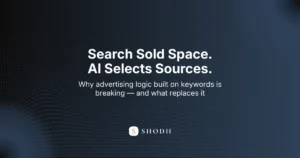
AI does not sell space. It selects sources.
The selection criteria are different from anything in the search advertising playbook. The AI assesses entity clarity — whether it can describe the business specifically and accurately. It assesses consistency — whether the business describes itself the same way across every source the AI reads. It assesses contextual fit — whether this entity belongs in the answer to this specific question, for this specific user, in this specific conversational context.
Budget influences whether a paid advertiser surfaces in preference to an organically equivalent competitor. It does not override the entity assessment. A business the AI cannot describe clearly will not be selected — regardless of what it is willing to spend.
This is the critical break from search advertising logic. In search, spend can compensate for weak brand signals — buy the top position and appear regardless of organic authority. In AI, spend operates within the constraints of entity trust. The constraint cannot be purchased around.
From Click Funnels to Decision Funnels
The mental model shift this requires is from click funnels to decision funnels.
The click funnel model optimised for traffic movement: impressions convert to clicks, clicks convert to landing page visits, visits convert to form fills or purchases. Every stage was measured by volume and rate. Success was clicks, conversions, cost-per-acquisition.
The decision funnel model operates differently. The stages are not impressions → clicks → conversions. They are problem articulation → context building → option narrowing → trust validation → recommendation → action. The AI system sits across the middle stages — helping the user build context, narrow options, and validate trust before any action is taken.
Advertising that operates within this funnel is not competing for a click. It is competing for inclusion in the reasoning. A brand that is included in the AI’s synthesis — mentioned as a relevant option, cited as a credible source, recommended as a fit for the user’s situation — has influenced the decision at a stage where click-based advertising cannot reach.
This is not interruption marketing. It is assisted decision influence.
The implication for measurement is significant. What AI visibility looks like when there are no clicks addresses this directly — because decision funnel influence frequently does not produce a traceable click even when it produces a sale.
What AI Advertising Actually Competes On
In search advertising, the competition variables are bid, quality score, and keyword relevance. These are execution variables — they can be managed at the campaign level by specialists with access to the right tools.
In AI advertising, the competition variables are entity clarity, positioning specificity, and cross-source trust coherence. These are not execution variables. They are structural variables — they reflect how the business describes itself, how consistently that description appears across sources, and how clearly the AI can understand what the business does and who it serves.
A business with strong entity signals will be selected more frequently, in more relevant contexts, and with stronger contextual fit than a business with weak entity signals — regardless of relative ad spend. The creative asset in AI advertising is not the ad. It is the entity.
This connects to what makes a brand trustworthy to AI systems and why preparing the website for AI answers is upstream of any advertising investment in this environment.
A Situation Worth Sitting With
A resort owner in Coorg is running Google Ads — good campaigns, reasonable cost-per-click, consistent bookings. Their digital marketing is working by every standard metric.
Someone planning a family trip — elderly parents, a ten-year-old, looking for something quiet and accessible — describes the situation to an AI assistant: “We want somewhere in the hills, not too far from Bangalore, comfortable for older people, not a party crowd. Maybe three nights.”
The AI synthesises a response. It mentions two properties. The Coorg resort with the well-managed Google Ads campaign is not one of them — not because it is a worse property, but because its entity signals do not clearly communicate accessibility for elderly guests or the specific quiet-family positioning the query requires.
The two properties mentioned receive consideration without any ad being served. The resort with the active campaign receives no consideration in this conversation — because the decision was shaped before any search happened.
Google Ads will continue to work for this resort when users search with formed intent. But a growing share of high-consideration hospitality decisions are beginning in conversations like this one — where AI shapes the shortlist before any search query is typed.
Would your business be in that shortlist?
What This Means for Indian Brands Specifically
India’s digital advertising ecosystem has been built substantially around Google Ads and Meta — both click-based, both keyword or interest driven, both measured by traffic and conversion metrics. That infrastructure will not disappear. But it is increasingly insufficient as the primary visibility strategy for categories where trust and specificity matter.
The opportunity for Indian brands is real and time-sensitive. AI advertising is not yet fully rolled out in India. The brands that build entity clarity now — before ChatGPT Ads scale, before AI recommendation patterns stabilise — will enter the paid channel with compounding advantages over those who arrive later.
Early movers in AI discovery do not just get first-mover timing. They get the compounding effect of consistent entity signals accumulating across sources over time. What we know about the ChatGPT Ads rollout in India provides the current timeline context. The preparation logic does not wait for that timeline.
AI Discovery vs Search Advertising: Key Questions Answered
These questions clarify how AI-driven discovery changes advertising logic, visibility, and decision influence compared to traditional search-based models.
Is AI replacing Google Ads?
Not replacing — repositioning. Search advertising remains effective for queries with formed, explicit intent. AI systems operate earlier in the decision process, shaping consideration before search queries are typed. For most Indian businesses, both channels will coexist and serve different stages of the user journey. The risk is not that Google Ads stops working — it is that the decisions most worth influencing are increasingly happening upstream of where Google Ads reaches.
Will websites still matter in an AI-driven advertising world?
Yes — but their function shifts. Websites become reference documents that AI systems evaluate for entity clarity, factual consistency, and trust signals. A website built only as a persuasion tool for human visitors may fail as a trust signal for AI systems. Both functions need to be served simultaneously.
How does AI decide which brands to mention or include?
Through entity clarity, positioning specificity, and cross-source consistency — not through bid alone. A brand that AI systems can describe accurately, specifically, and with confidence in a given context will be included more frequently than a brand with ambiguous or inconsistent signals, regardless of relative ad spend.
Are ChatGPT Ads available in India yet?
As of early 2026, ChatGPT Ads are in limited global rollout and not yet fully available to Indian advertisers. The preparation window — before mass availability — is the most strategically valuable period for Indian businesses to build the entity foundations that AI advertising depends on.
What is the single most important thing a business can do to prepare for AI advertising?
Build entity clarity — ensure the business is described specifically, consistently, and verifiably across every surface an AI system reads. This is not a campaign action. It is a structural one that precedes and enables every advertising investment that follows.

Anurag Gupta


All content on this site: Copyright © 2026 ShodhDynamics. All rights reserved, including those for text and data mining, AI training, and similar technologies. This includes frameworks, lexicons, research papers, and books published on this platform. Unauthorized reproduction or use without explicit written permission is prohibited.