

How to Read AI Audience Intent vs Keyword Intent
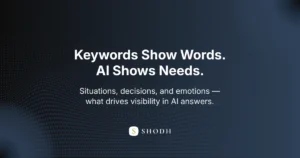
Keywords show what was typed. AI intent reveals what the user actually needs — and why most businesses invisible to AI answers are missing the mark.

AI Discovery · AI Recommendations · ChatGPT India
Keywords tell you what a user typed. AI intent tells you who they are, what they’ve tried, what matters to them, and how close they are to acting. Getting this wrong means your business may be invisible — even with perfect SEO.
Keyword Intent vs AI Audience Intent: Quick Comparison
| Aspect | Keyword Intent | AI Audience Intent |
|---|---|---|
| Input | Words typed | Words + context + constraints + emotional cues |
| Depth | Shallow | Multi-layer (situational, emotional, decision stage, constraints) |
| Output | Matches category | Matches real decision context |
| Business Visibility | Limited | Dependent on entity signal quality |
| Optimization | SEO, content category | Entity clarity, real-world specificity |
AI systems match businesses to real decision contexts, not just keywords — entity clarity drives visibility.
What Keywords Actually Capture
Keyword intent analysis was built on a useful simplification: categorise what someone typed, infer what they want, serve them the most relevant page.
The categories are familiar. Informational — the user wants to learn. Navigational — they want to find a specific place. Transactional — they are ready to act. Commercial — they are comparing before acting. For two decades this framework shaped how businesses created content, structured pages, and bid on ads.
It worked because it was better than nothing. Knowing that “best IVF clinic Goa” was a commercial-intent query told a marketer something useful about what the searcher wanted and how to respond to it.
What it could not capture was the person behind the query — the situation, the history, the emotional weight, the specific decision context that made that particular search different from every other search using the same words.
Keywords read the surface. They were never designed to read deeper.
What AI Systems Actually Infer
Consider this query, posed to ChatGPT:
“I have had two failed IVF cycles, spent a significant amount of money, and gone through a lot emotionally. I cannot afford another wrong decision. Who should I consider in Goa?”
A keyword tool processes this and finds: IVF, Goa, consideration. Commercial intent, local modifier. Serve a list of IVF clinics in Goa with strong reviews.
An AI system reads something fundamentally different. It reads a person at a specific point in a high-stakes, emotionally loaded journey. It reads the constraint — not just location, but the weight of prior failure and financial exposure. It reads the decision proximity — this person is not researching generally, they are ready to choose but need to trust before they commit. It reads the implicit ask — not just who exists, but who is credible, experienced, and safe enough to recommend to someone in this situation.
The AI’s response will not be a list of clinics ranked by SEO metrics. It will reflect a judgement about which entities it can confidently recommend to a person in this specific circumstance — which means the entities it surfaces need to have signals that align with that circumstance: demonstrated expertise, patient trust, consistent credibility across sources.
Keywords tell you what someone typed. AI intent tells you what they actually need — and who they need to trust.
The clinic that appears in that ChatGPT response earned that inclusion not through keyword optimisation but through the coherence and specificity of its entity signals. The clinic that does not appear may have identical SEO metrics and a missing entity foundation.
This is the gap. And it exists across every industry and every decision context — not just healthcare.
The Multi-Layer Nature of AI Intent
Where keyword intent is a single-dimension categorisation, AI intent inference operates across several layers simultaneously.
Situational layer: What is the user’s current circumstances? Are they early in a process or late? Have they already tried something that did not work? A resort in Coorg being asked about by someone planning a quiet anniversary is in a different situation than one being asked about by a corporate travel manager booking a team offsite. Same location, same category, different intent entirely.
Emotional layer: What is the emotional register of the query? A D2C skincare brand asked about by someone who has “tried everything for sensitive skin” is being approached by a person who is frustrated, cautious, and sceptical of claims. An AI system reading that context will favour brands whose entity signals communicate specificity and trustworthiness over brands that communicate enthusiasm and reach.
Decision layer: How close is this person to acting? A property buyer in Pune asking “what should I know before buying a flat in Wakad” is in a different decision stage than one asking “which developer in Wakad has delivered projects on time.” The second query has a decision closer to execution — and the AI’s response will reflect that, favouring entities with verifiable delivery records over those with general positioning.
Constraint layer: What limitations is the user working within — budget, location, time, prior experience, risk tolerance? These constraints shape which entities are relevant matches for the full intent, not just the surface category.
Keyword intent tools capture none of these layers reliably. AI systems infer all of them from the phrasing, the context, and the conversational history.
Why This Breaks Most Content Strategies
Most content created for SEO is written to match keyword intent categories. Informational content answers the informational query. Commercial content targets the comparison query. Landing pages target the transactional query.
This content performs well for retrieval — it is findable, rankable, and structured to match what a search engine expects. It often fails for AI intent matching because it was written for a query category, not for a real decision context.
A real estate developer’s website that has a page titled “Flats for Sale in Wakad Pune” optimised for that keyword is speaking to a search category. An AI system reading for intent may encounter a user who wants to understand which developers in Wakad have a track record of handing over projects without construction defects — a specific, trust-heavy intent that the keyword-optimised page does not address at all.
The content exists. The SEO is intact. The AI intent match is absent.
This is why businesses that have invested heavily in content marketing can still be consistently absent from AI answers in their own category. The content was written for the wrong reader — not wrong in the sense of inaccurate, but wrong in the sense of addressing a search algorithm’s categorisation logic rather than a real person’s decision context.
Why most websites are invisible to AI even with good SEO covers the structural dimension of this failure. The intent dimension is the content layer of the same problem.
What Strong Intent Alignment Actually Looks Like
A business whose content and entity signals align with real decision contexts — not keyword categories — will be a stronger match for AI intent inference across a wider range of queries.
This does not mean abandoning structured content or ignoring search. It means writing from the inside of a real decision rather than from the outside of a keyword category.
A custom kitchen and wardrobe company in Bengaluru that describes itself as helping homeowners make irreversible material choices with confidence — because selecting cabinetry for a home you are building once is a one-way decision — is speaking to a real decision context. An AI system reading a query from someone renovating their home who is anxious about making permanent choices will find that entity a coherent match.
A hotel in Goa that positions itself around the specific experience of families travelling with elderly parents — the accessibility, the pace, the kind of attention that makes that combination work — is a coherent match for a very specific intent that a generic “luxury resort Goa” entity is not.
Specificity of positioning is not a niche limitation. It is an intent matching advantage. The more precisely a business describes who it serves and in what situation, the more confidently an AI system can include it in answers where that situation is present.
The Readiness Question This Raises
The honest question this post opens is not “how do we optimise for AI intent” — that framing leads back to tactics and checklists, which is not the territory this site covers.
The honest question is: if an AI system were to read everything your business has published about itself — your website, your descriptions, your content — would it be able to infer the real decision contexts you serve?
Not the keyword categories. The real situations. The emotionally loaded queries. The people at the specific point in their journey where your business is actually the right answer.
If the answer is uncertain, that is the gap the AI Discovery Readiness Check is designed to surface — not as a sales process, but as an honest diagnostic of where entity signals align with intent and where they do not.
India Context
For Indian businesses, the gap between keyword-focused SEO and AI intent is amplified in high-stakes sectors — healthcare, fintech, edtech — where conversational queries reveal constraints and urgency that keywords alone cannot capture.
What Comes Next
Understanding intent is one part of the AI Discovery picture. The other is understanding why businesses that have done everything right by traditional metrics — good SEO, strong content, solid rankings — are still absent from AI answers. That structural question is addressed in Why Most Websites Are Invisible to AI Even With Good SEO — the next post in this series.
And for the broader context of how the discovery layer works before any intent is even read, The New Attention Layer — AI Discovery Funnels is the preceding post.
FAQs: AI Audience Intent vs Keyword Intent
What is AI audience intent?
AI audience intent is the full picture of what a user needs — their situation, emotional state, decision stage, and unstated expectations — as inferred by an AI system from the way a question is phrased. A query like “which resort in Coorg is good for a quiet anniversary” carries far more intent signal than the keywords it contains, and an AI system reads all of it.
How is AI intent different from search keyword intent?
Keyword intent categorises queries by type — informational, navigational, transactional, commercial. AI intent reads the full conversational context — the situation, the constraint, the emotional weight, the decision proximity. A keyword tool sees “IVF clinic Goa” as a local commercial query. An AI system reading “I have had two failed IVF cycles and cannot afford another wrong decision — who should I trust in Goa?” understands a person at a specific, high-stakes decision point who needs reassurance, specificity, and credibility — not a list of clinics.
Why does intent reading matter for whether a business appears in AI answers?
Because AI systems match businesses to the full intent of a query, not just its keywords. A business described generically matches the keyword but may not signal the specificity and trust that the deeper intent requires. A business whose entity signals communicate relevant experience and credibility for the specific situation is a stronger match — and therefore more likely to be included in the response.
Can businesses influence how AI reads their intent relevance?
Not directly — but they can build entity signals that make them a strong match for the intents most relevant to their business. This means describing the business in language that reflects real decision situations — not generic category language written for keyword algorithms.
Does conversational intent apply only to ChatGPT or across all AI systems?
Conversational intent inference is consistent across modern AI answer systems — ChatGPT, Gemini, Claude, Perplexity, and others all interpret queries beyond keyword matching. The specific weighting differs by platform, but businesses that build entity signals aligned with real decision contexts will be better positioned across all of them.

Anurag Gupta


All content on this site: Copyright © 2026 ShodhDynamics. All rights reserved, including those for text and data mining, AI training, and similar technologies. This includes frameworks, lexicons, research papers, and books published on this platform. Unauthorized reproduction or use without explicit written permission is prohibited.