

Why ChatGPT Doesn’t Mention Your Business (And What That Actually Means)
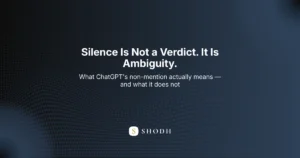
ChatGPT doesn’t mention your business when it cannot confidently verify and describe it as an entity across multiple sources.
When a business discovers that ChatGPT does not mention them — in their own category, in their own city — the instinct is to treat it as a competitive loss. It is not. Absence from AI answers is almost always a structural signal about entity clarity, not a judgement about quality. This post explains what non-mention actually means, why good businesses get missed, and why ads cannot solve a comprehension problem.

AI Visibility · Entity Clarity
ChatGPT doesn’t mention your business because it lacks a confident, consistent model of what your business is. This usually happens due to entity ambiguity, weak third-party corroboration, or inconsistent descriptions across sources. It is not a penalty or quality judgement — it is a confidence problem. If the AI cannot verify and describe you clearly, it will not include you in its answers.
Why ChatGPT Doesn’t Mention Your Business (Direct Answer)
A business is not mentioned in ChatGPT responses when the AI system cannot confidently verify and describe it. This typically happens due to:
- Entity ambiguity — the business is described in generic or indistinguishable terms
- Lack of third-party validation — minimal independent mentions or corroboration
- Inconsistent positioning — different descriptions across pages and platforms
- Weak comparative presence — absence from reviews, roundups, or category discussions
ChatGPT does not “rank” businesses. It includes only those it can describe with confidence in a given context. If that confidence is missing, the business is omitted — regardless of quality or reputation.
The Panic Behind the Question
This is increasingly being asked as: “Why is my business not showing in ChatGPT?”, “Why does ChatGPT not recommend my company?”, or “Why am I missing from AI answers in my city?”
The moment tends to follow a pattern. Someone in the business — a founder, a marketing manager, a curious team member — asks ChatGPT a question about their category. They name the city. They describe the need. They expect to see their business in the response.
They do not.
A competitor appears. Sometimes a business they regard as less capable, less established, or less deserving. The response feels like a verdict — a public declaration that the business does not belong in the conversation about its own category.
The instinct that follows is competitive: “why them and not us?” The framing is adversarial. The assumption is that something has been done wrong, or that something needs to be done to reverse a decision that has been made against them.
Both the instinct and the assumption are wrong in a specific, useful way. ChatGPT’s non-mention is not a competitive decision. It is not a quality assessment. It is a comprehension limitation — the AI system does not have sufficient, consistent, confident information about the business to include it in an answer. The absence reflects the AI’s uncertainty, not the business’s inadequacy.
Improving this requires clearer positioning, consistent cross-source descriptions, and independent validation — not more keywords or better rankings.
AI Mentions Are Not Rankings
The SEO mental model that most people bring to this question makes it harder to understand. In search, not appearing is a ranking problem — the page exists but is not ranked highly enough to be shown. The solution is ranking improvement: better content, more links, stronger signals.
AI mentions do not work this way. There is no ranked list of businesses from which the top results are selected for inclusion in the answer. There is a comprehension process — the AI constructs a model of relevant entities and includes those it can describe with sufficient confidence in the context of the specific question being asked.
A business is not excluded from an AI answer because it ranked below the inclusion threshold. It is excluded because the AI’s model of it is insufficiently confident, specific, or consistent to support a recommendation. The problem is comprehension, not position. And comprehension cannot be improved by the same signals that improve ranking.
This is why businesses with strong SEO — high rankings, good traffic, solid domain authority — are often just as absent from AI answers as businesses with weak SEO. The signals that drive ranking and the signals that drive AI comprehension overlap partially but are not the same. Why most websites are invisible to AI even with good SEO covers that gap specifically.
What This Is Not
ChatGPT not mentioning your business does NOT mean:
- Your competitors are objectively better
- Your SEO is weak
- Your website is invisible to Google
- The system is biased against you
It means the AI cannot confidently model your business as an entity.
The Most Common Reasons for Non-Mention
Non-mention is not random. It follows from specific, diagnosable gaps in how a business is represented across the sources AI systems read.
Entity ambiguity. The business describes itself in terms that are generic enough to apply to hundreds of competitors. The AI cannot distinguish it from others in the same category and therefore cannot confidently recommend it for a specific context. Ambiguity produces omission.
No consensus across sources. The AI reads across multiple sources to build confidence in an entity description. A business that exists primarily on its own website — with sparse independent mentions, minimal directory presence, and no third-party references — gives the AI only self-reported evidence. Self-reported evidence without corroboration produces low confidence. Low confidence produces non-mention.
Absence from comparison contexts. AI systems draw on content that frames businesses in comparative terms — reviews, roundups, category discussions — to build models of how entities relate to each other within a category. A business that has never appeared in any comparative context is harder for AI systems to position accurately. It exists in the AI’s information environment, but without the relational signals that tell the system where it belongs.
Over-reliance on owned content. Websites, social profiles, and published content that the business controls are the starting point — not the foundation. AI trust requires independent corroboration. A business that has invested heavily in owned content without building external presence has built a strong signal that the AI weights less heavily than it appears to deserve.
Absence Does Not Mean Low Quality
This is the reassurance that the panic obscures: good businesses get missed by AI systems all the time. The correlation between AI mention and business quality is loose at best. AI systems favour clarity over excellence — a business that is clearly, specifically, and consistently described will surface before a better business that is generically or inconsistently described.
A fifteen-year specialist in a niche field who has built their reputation through client relationships and word-of-mouth — and who has invested little in structured external presence — will be absent from AI answers that mention a younger, less experienced competitor with stronger entity signals.
This is not a just outcome. It is the current structural reality of how AI comprehension works. The AI does not have access to the depth of knowledge that the specialist’s clients have. It has access to what is described, consistently and verifiably, across the sources it can read.
Understanding this reframes the problem from competitive to structural — and structural problems have structural solutions that are independent of competitive anxiety.
Why Ads Don’t Solve This
The compensatory instinct — if organic AI presence is absent, pay for it — does not work in this context for reasons that are now familiar from the rest of this series.
ChatGPT Ads depend on the AI’s existing understanding of the advertiser’s business. A paid placement surfaces the business within a response — but the AI still needs to describe it. If the entity model is thin or ambiguous, the paid mention inherits that ambiguity. The ad surfaces a business the AI cannot describe clearly, into a response that depends on clear description for its trust value.
The result is a mention that feels promotional rather than considered — precisely the quality that makes AI recommendations trustworthy is absent when the entity behind the recommendation is not well understood. Paid placement amplifies existing AI comprehension. It cannot substitute for comprehension that does not exist.
The three conditions under which ChatGPT Ads actually fail covers this in full. Entity ambiguity is the second failure condition — and it is the one that paid budgets most frequently encounter without recognising.
What This Absence Actually Tells You
Non-mention is not the end of an analysis. It is the beginning of a useful one.
If ChatGPT does not mention your business in relevant queries, the most productive question is not “how do we get mentioned?” It is “what does the AI currently understand about us — and where is that understanding incomplete, inconsistent, or absent?”
That diagnostic is more useful than any competitive comparison. It points toward specific, addressable gaps: positioning language that is too generic, external presence that is too thin, descriptions that conflict across sources, facts that are stated on the website but not corroborated anywhere else.
You are not yet recognised. Discovery precedes promotion. Recognition precedes recommendation.
The AI Discovery Readiness Check is designed to surface exactly this — not as a competitive benchmarking exercise, but as an honest diagnostic of where the signals that support AI recognition currently hold and where they do not.
Frequently Asked Questions About ChatGPT Not Mentioning Your Business
Does ChatGPT penalise businesses for any reason?
No. ChatGPT does not penalise businesses in the way that search engines apply manual or algorithmic penalties. Non-mention is not a punishment — it is a reflection of the AI’s confidence level in its model of the entity. A business that is not mentioned has not done something wrong. It has, in most cases, not yet given the AI system enough consistent, corroborated information to recommend it confidently.
If a competitor is mentioned and we are not, does that mean they are winning?
Not in a competitive sense — it means they have stronger entity signals for the specific query context. The AI’s inclusion of a competitor reflects the clarity and consistency of that competitor’s entity signals, not a judgement that the competitor is superior. The gap is a signal about entity clarity, not market position.
Can the same business be mentioned in some AI queries and not others?
Yes — and this is common. AI inclusion depends on contextual fit, not just entity recognition. A business may be mentioned in response to one type of query and absent from another, because its entity signals are stronger for one context than the other. This is diagnostic information about which aspects of the business’s positioning are well-established versus underdeveloped in the AI’s model.
How long does it take to go from non-mention to consistent AI mention?
There is no fixed timeline — it depends on how quickly consistent, specific, corroborated entity signals accumulate across sources the AI reads. Businesses that address the root causes systematically — clarifying positioning, building external presence, ensuring cross-source consistency — typically see gradual improvement over months rather than weeks. There is no shortcut that produces immediate inclusion.
Is non-mention in ChatGPT the same as non-mention in Gemini or Perplexity?
Not necessarily identical — each AI system has its own training data and weighting. But the underlying causes of non-mention are consistent across platforms: entity ambiguity, absence of cross-source corroboration, and generic positioning all reduce AI confidence across systems. A business that addresses these structural gaps will improve its position across all AI answer systems, not just ChatGPT.

Anurag Gupta


All content on this site: Copyright © 2026 ShodhDynamics. All rights reserved, including those for text and data mining, AI training, and similar technologies. This includes frameworks, lexicons, research papers, and books published on this platform. Unauthorized reproduction or use without explicit written permission is prohibited.