

The New Attention Layer — AI Discovery Funnels
AI systems have a discovery layer that runs before search, before ads, and before any user interaction. It is the layer where AI decides which businesses belong in an answer — built from entity signals accumulated over time, not from campaigns or clicks. Businesses either exist in that layer or they do not. This post explains how that layer works, why attention now flows through it, and what it means for brands that have been optimising for a funnel that no longer starts where they think it does.

AI Discovery · AI Visibility · ChatGPT India
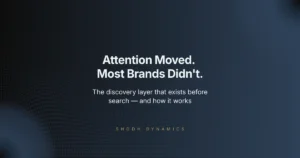
Where does attention actually go now — if not to search results? Attention has not disappeared. It has moved upstream. Before a user reaches a search result, an ad, or a website, AI systems have already filtered the field — deciding which businesses belong in the answer and which do not. The discovery funnel now has a layer that most businesses cannot see, have no metrics for, and are not yet building for. This post explains what that layer is and how attention flows through it.
Attention Was Never the Goal. Discovery Was.
For as long as digital marketing has existed, brands have chased attention — impressions, reach, share of voice. The logic was sound: attention preceded discovery. Be visible enough, in enough places, to enough people, and discovery would follow.
That logic held because attention and discovery were sequential. A user noticed a brand, became curious, searched, compared, decided. Attention was the entry point. Without it, nothing else in the funnel triggered.
What has changed is not the importance of discovery. It is the assumption that attention must come first.
AI systems discover — or more precisely, recognise — businesses through a process that has no public attention stage. There is no moment where a brand gets an impression, earns a click, or registers a view. Recognition happens internally, built from signals accumulated over time, and it either exists when a user asks a question or it does not. The attention stage, as it was understood, has been bypassed entirely for this layer of discovery.
What a Discovery Funnel Actually Is
A discovery funnel is the sequence through which a potential customer moves from unaware to considering. In the old model that sequence was observable: attention led to interest, interest led to search, search led to comparison, comparison led to decision. Each stage took time, left traces, and gave brands opportunities to intervene.
The AI-mediated funnel compresses that sequence into a single step. A user poses a question. An AI system synthesises a response that already reflects awareness, comparison, and a preliminary decision. The user receives a shortlist — sometimes a list of one — without having moved through any of the intermediate stages independently.
The funnel did not get longer. It got faster and invisible.
The mechanics of why this happens — how AI systems filter and select before the response is written — are covered in depth in The Decision Funnel Has Changed. What matters here is the structural consequence: the stages where brands used to compete are no longer accessible. The competition happened earlier, in a place most brands were not paying attention to.
The Layer That Appeared Above Search
There is now a layer of discovery that sits above search, above ads, and above content marketing. It is the layer where AI systems decide which entities belong in an answer — not by retrieving pages, but by drawing on their trained understanding of which businesses are clear, consistent, and trustworthy enough to recommend.
This layer is not a ranking layer. There is no position one or position ten. There is inclusion or there is absence. A business either exists in the AI’s confident model of its category or it does not.
It is also not a layer with an obvious entry point. There is no campaign to run, no bid to place, no optimisation checklist that unlocks access. Recognition within this layer is built from entity signals — the clarity, consistency, and coherence with which a business is described across every surface an AI system reads.
You cannot buy into this layer. You can only earn recognition within it.
This is the layer that AI Discovery as a discipline is concerned with — not as a tactic, but as a precondition for everything else that follows.
How Attention Flows Through This Layer
When a user asks an AI system a question, attention flows to the answer. Within that answer, attention distributes to the entities mentioned — the businesses named, the solutions described, the brands included. Entities not mentioned receive no attention. Not reduced attention. Zero.
This is a more extreme concentration dynamic than search ever produced. On a search results page, position ten still received some clicks. A brand on page two was discoverable to motivated users. The distribution of attention was unequal but not binary.
In an AI answer, the distribution is close to binary. Included entities receive the user’s full consideration within that response. Excluded entities do not exist in that conversation. A user who receives a confident AI recommendation has no particular reason to look beyond it — which is precisely why they asked an AI rather than conducting an open-ended search.
OpenAI’s ChatGPT Shopping surfaces up to 36 curated product recommendations per query — a hard ceiling that makes the inclusion/exclusion dynamic concrete. The brands in those 36 exist in that transaction. The rest do not.
The entity-level mechanics behind why some businesses are included and others are not — entity clarity, trust signals, cross-source coherence — are explained in the AI Discovery pillar. The point here is simpler: attention in this model flows exclusively to recognised entities, and recognition is built before the conversation begins.
Why This Funnel Is Harder to See Than the Old One
The old funnel left evidence. Impressions, sessions, bounce rates, conversion paths — the stages were traceable, however imperfectly. Teams could see where users dropped off and adjust accordingly.
The AI discovery funnel leaves no equivalent trace. There are no impression counts for AI mentions. No click attribution for recommendations that did not generate a visit. No position tracking for inclusion in a synthesised response. The funnel runs inside the model, not inside the browser, and current analytics infrastructure has no visibility into it.
The emerging response to this gap — querying AI systems directly and systematically to audit what they say about your brand and your category — is the beginning of what is now being called agentic observability.
The result is that capable, attentive marketing teams are operating with a significant blind spot — not from negligence, but because the tools built to measure the old funnel simply cannot see the new one.
What This Means for How Brands Should Think
The practical implication of this layer is a shift in how the visibility question is framed.
The old question was: how do we get found? The answer involved SEO, ads, content, and distribution — all mechanisms for inserting the brand into the discovery sequence after a user had already started looking.
The new question is: are we already known to the system that does the finding?
Brands that AI systems can describe clearly, consistently, and confidently are inside the discovery funnel before any user asks. Their visibility is pre-established. When a relevant question is posed, they are candidates. Brands that AI systems cannot describe with confidence are outside the funnel — regardless of how much they subsequently invest in being found.
Being discoverable used to mean being retrievable. Now it means being pre-recognised.
This is not a reason to abandon existing marketing investments. Search, content, and paid channels all contribute to the signal environment that AI systems learn from. But it is a reason to treat AI recognition as a precondition rather than an outcome — something that must be established before other visibility investments can operate at full effectiveness.
What Comes Next
This post establishes that the discovery layer exists and that attention flows through it differently than it did through search. The next logical question is about intent — specifically, how AI systems interpret what users are actually looking for, and why that interpretation differs from how keyword-based systems read queries.
That question is answered in How to Read AI Audience Intent vs Keyword Intent — the next post in this series.
If you arrived here before reading From Search Results to AI Answers, that post provides the structural context for why the sequence changed — which makes this layer easier to understand in full.
For the broader commerce context — what happens after AI discovers a brand and how the transaction itself is changing — the Conversational Commerce and Agentic Commerce framework is covered in Discovery to Conversion.
Frequently Asked Questions AI Discovery Funnels
What is an AI discovery funnel?
An AI discovery funnel is the sequence through which a potential customer moves from unaware to considering — mediated by an AI system rather than a search engine. Where the old funnel moved through attention, search, comparison, and decision across multiple sessions, the AI discovery funnel compresses those stages into a single AI-synthesised response. The business is either included in that response or it is not. There is no middle ground between visibility and invisibility in this model.
How is the AI discovery funnel different from a traditional marketing funnel?
The traditional funnel was observable and interruptible — brands could reach users at each stage through ads, content, and retargeting. The AI discovery funnel runs internally, inside the model, before the user sees anything. Brands cannot intercept users mid-funnel because the funnel completes before any public interaction occurs. The only way to be present in the AI discovery funnel is to already be recognised by the system before the user asks.
Can a business enter the AI discovery layer through paid ads?
Not directly. The AI discovery layer is a comprehension and trust layer — it is built from entity signals, factual consistency, and cross-source coherence, not from ad spend. Paid exposure inside AI answers (for example, ads within ChatGPT) sits on top of this layer and depends on it. A business that has not established recognition within the discovery layer will find that paid placement has a weak foundation to amplify.
Why do brands with high search visibility still miss the AI discovery layer?
Because search visibility and AI recognition are built from different signals. Search rewards keyword relevance, link authority, and technical performance. The AI discovery layer rewards entity clarity, semantic consistency, and cross-source trust coherence. A brand optimised entirely for search may have strong retrieval signals and weak comprehension signals at the same time — visible in results pages, absent from AI answers.
Is the AI discovery funnel the same across ChatGPT, Gemini, and Claude?
The underlying mechanics are consistent across modern AI answer systems — entity recognition, trust inference, and answer synthesis operate similarly regardless of platform. While each system applies its own weighting and constraints, a business with strong entity clarity and coherent trust signals will be better positioned across all of them. This site uses ChatGPT as its primary reference given its market reach in India, but the discovery principles are model-agnostic and apply equally to Gemini and Claude.

Anurag Gupta


All content on this site: Copyright © 2026 ShodhDynamics. All rights reserved, including those for text and data mining, AI training, and similar technologies. This includes frameworks, lexicons, research papers, and books published on this platform. Unauthorized reproduction or use without explicit written permission is prohibited.