

ChatGPT Ads vs Google Ads — Why This Is a Different Game
ChatGPT Ads are not Google Ads with a conversational interface. The trigger is different, the placement logic is different, the measurement is different, and the creative asset that determines performance is different. This post explains the structural differences — not to declare a winner, but to ensure Indian marketers do not apply Google Ads thinking to a system that operates on entirely different principles.

Generative AI Marketing · ChatGPT India
The most dangerous assumption an Indian marketer can bring to ChatGPT Ads is that it works like Google Ads with a different interface. It does not. Google Ads is a keyword-auction system where spend and quality score determine position. ChatGPT Ads is a trust-mediated system where the AI’s confidence in the advertiser’s entity determines whether placement occurs at all. These are not variations of the same model. They are different systems built on different logic, rewarding different inputs — and failing in ways that have no equivalent in the other. Google Ads optimises for visibility. ChatGPT Ads filters for trust before visibility exists.
What is the difference between Google Ads and ChatGPT Ads?
The primary difference lies in the delivery logic: Google Ads is a keyword-auction system built for search visibility, while ChatGPT Ads is a trust-mediated system designed for conversational inclusion. While Google rewards spend and Quality Score, ChatGPT rewards entity clarity and contextual relevance.
Trigger Mechanism: Google Ads uses discrete keyword queries; ChatGPT Ads uses situational inference based on the entire conversation state.
Placement Model: Google placements are positional (ranked lists on a page), whereas ChatGPT placements are inclusion-based (binary mentions within a synthesized response).
Trust Requirement: In Google, trust is not a prerequisite for visibility. In ChatGPT, entity confidence is a condition of participation; the AI must trust your brand before it will recommend it.
Creative Asset: Google focuses on ad copy and landing pages; ChatGPT requires a machine-readable entity foundation—how consistently your business is described across the digital ecosystem.
Measurement: Google relies on mature click-based attribution, while ChatGPT measurement is influence-based, as brand mentions often shape decisions without generating a traceable click.
Trigger Mechanism: Google Ads uses discrete keyword queries; ChatGPT Ads uses situational inference based on the entire conversation state.
Placement Model: Google placements are positional (ranked lists on a page), whereas ChatGPT placements are inclusion-based (binary mentions within a synthesized response).
Trust Requirement: In Google, trust is not a prerequisite for visibility. In ChatGPT, entity confidence is a condition of participation; the AI must trust your brand before it will recommend it.
Creative Asset: Google focuses on ad copy and landing pages; ChatGPT requires a machine-readable entity foundation—how consistently your business is described across the digital ecosystem.
Measurement: Google relies on mature click-based attribution, while ChatGPT measurement is influence-based, as brand mentions often shape decisions without generating a traceable click.
The Comparison That Needs to Be Made Carefully
Comparing ChatGPT Ads to Google Ads is useful — it gives marketers a familiar reference point. It is also dangerous — it imports assumptions that do not apply and can lead to strategies that are structurally wrong for the new system.
The useful version of this comparison is not “which is better” or “which will win.” Both will coexist for the foreseeable future, serving different query types and different stages of the user journey. The useful comparison is structural — understanding how the two systems differ at the level of trigger, placement, trust requirements, and measurement. That understanding is what allows a marketer to approach ChatGPT Ads as its own discipline rather than an extension of existing practice.
The Structural Difference — At a Glance
| Aspect | Google Ads | ChatGPT Ads |
|---|---|---|
| Trigger | Keyword query | Conversation state (context + intent) |
| Placement | Position on results page | Inclusion within generated response |
| Visibility Model | Ranked list (multiple positions) | Binary (mentioned or not mentioned) |
| Targeting Logic | Keyword + bid + quality score | AI interpretation of relevance |
| Trust Requirement | Not required for visibility | Required before inclusion |
| Creative Asset | Ad copy + landing page | Entity clarity + consistent description |
| Optimisation Lever | Keywords, bids, CTR, quality score | Entity signals, trust, contextual relevance |
| Retargeting | Core capability | Not available |
| Measurement | Click-based attribution | Influence + partial attribution |
| Failure Mode | Low ranking / high CPC | Complete absence (not surfaced at all) |
Note: The Cost Factor: Google allows for low-barrier entry (as low as ₹500/day) with a CPC model. Whereas ChatGPT Ads minimum spend requirement is removed entirely on May 5, 2026, update
The Trigger — Query vs Conversation
Google Ads: A user enters a search query. The system matches the query against advertiser bids. The highest relevant bidder for that query appears. The trigger is discrete, specific, and well-defined — a keyword or phrase entered at a specific moment.
ChatGPT Ads: There is no discrete query-to-ad match. The trigger is conversation state — the AI’s interpretation of the full context of an interaction, including what the user has asked, how they have framed it, what they appear to be trying to resolve, and how far along a decision they seem to be. The trigger is not a keyword. It is a situational inference.
This difference has a specific practical implication. In Google Ads, an advertiser can examine search term reports, identify exactly which queries triggered their ads, and optimise accordingly. In ChatGPT Ads, the trigger is the AI’s interpretation of a conversation — which is not reducible to a keyword list and cannot be managed through bid adjustments against specific terms.
Advertisers who expect to optimise ChatGPT Ads the way they optimise Google Ads — through keyword expansion, negative keyword lists, and match type refinement — will find the system does not offer equivalent controls, because the system does not operate on keyword matching.
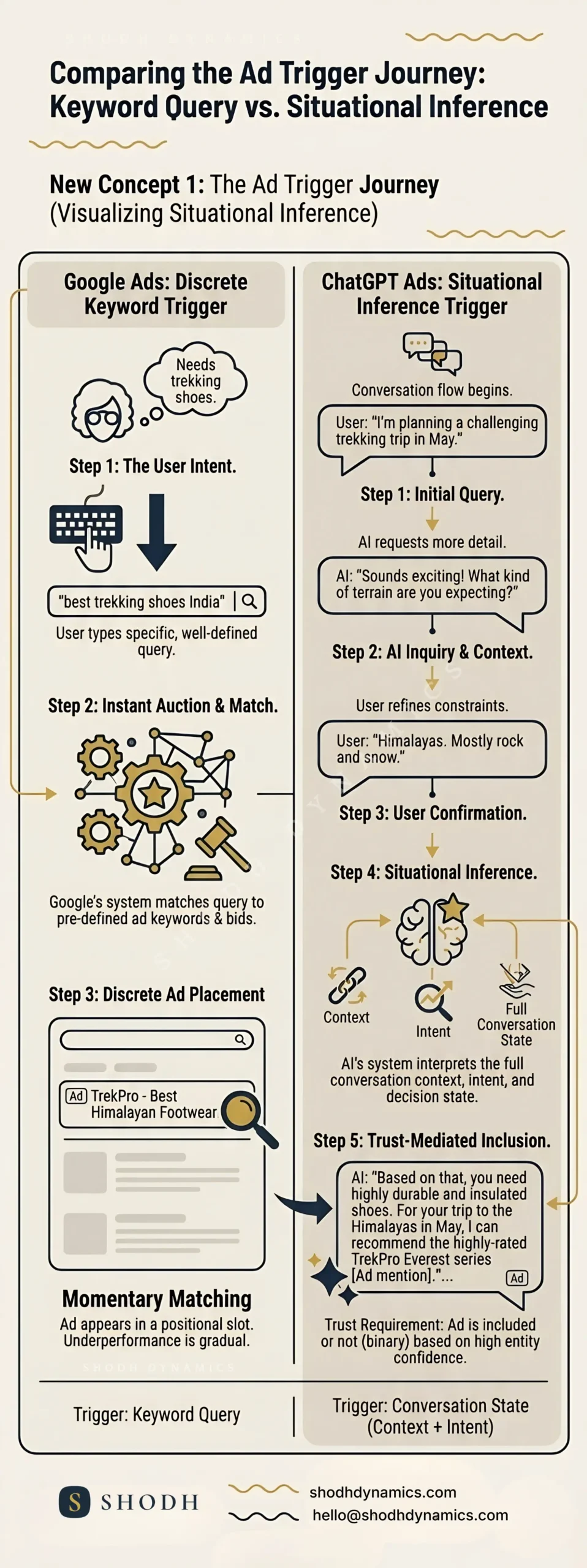
The Evolution of the Trigger: Unlike the discrete keyword-match model of traditional search, ChatGPT Ads rely on the AI’s interpretation of the full conversation state—intent, context, and situational inference.
The Placement — Position vs Inclusion
In Google Ads, underperformance is gradual — you move from position one to position four to position ten.
In ChatGPT Ads, underperformance is absolute — you disappear.
Google Ads: Placement is positional. There is a page. There are positions on that page. The advertiser buys a position — above organic results, within shopping units, in display zones. The ad occupies a defined space, visually separated from organic content, labelled as sponsored in a consistent location.
ChatGPT Ads: Placement is inclusion-based. There is no page with fixed positions. There is a response — generated fresh for each conversation — and the advertiser is either included in that response or not. The placement is not a position within a fixed layout. It is a mention within a synthesised answer, appearing where contextually appropriate, labelled as sponsored within the conversational flow.
The winner-takes-most dynamic of ChatGPT Ads placement is more extreme than Google Ads. On a search results page, position four still appears. Position ten still gets some clicks. In a ChatGPT response, the businesses mentioned are present. The businesses not mentioned are absent. There is no position ten that still generates some traffic. Inclusion or exclusion is binary.
The Trust Requirement — Quality Score vs Entity Confidence
Google Ads: The quality score system rewards relevance between the ad, the keyword, and the landing page experience. A high quality score reduces cost-per-click and improves position. Trust in the advertiser, as a business entity, is not directly evaluated by the system — the ad can appear regardless of whether the business is credible, as long as the policy requirements are met and the quality score is sufficient.
ChatGPT Ads: Entity trust is a prerequisite for placement, not a modifier. The AI system evaluates whether it has sufficient confidence in the advertiser’s business — whether it can describe it accurately, whether it trusts the description against independent sources — before placing any ad. An advertiser with low entity confidence may find their ads do not surface even when the conversation state is relevant, because the AI is not willing to recommend an entity it cannot confidently describe.
This is the most consequential structural difference for Indian marketers. Google Ads allows spend to compensate for brand ambiguity — a business the user has never heard of can appear at the top of search results through bidding. ChatGPT Ads does not offer this compensation. Entity clarity is not something that can be bought around. It is a condition of participation.
How entity trust determines ChatGPT Ads performance explains this in full. What makes a brand trustworthy to AI systems covers what building that trust actually requires.
The Creative Asset — Ad Copy vs Entity Description
Google Ads: The creative asset is the ad — headline, description, extensions, landing page. Copywriting skill, A/B testing, and conversion rate optimisation are the levers that determine creative performance.
ChatGPT Ads: The creative asset is the entity — how clearly, specifically, and consistently the business is described across all the surfaces the AI reads. The ad creative inputs matter, but they operate on top of an entity foundation. If the foundation is weak, no amount of creative optimisation will compensate.
This shifts where creative investment should go. The most important creative work for ChatGPT Ads happens before the campaign launches — in how the business describes itself across its website, its external profiles, and its published content. The copywriter’s most valuable contribution is not the ad headline. It is the entity description that gives the AI system enough to work with.
The Measurement — Attribution vs Influence
Google Ads: Click-based attribution is the standard measurement framework. Clicks, conversions, cost-per-acquisition, and return on ad spend are all traceable back to specific ad interactions. The measurement infrastructure is mature, well-integrated with analytics platforms, and capable of session-level attribution.
ChatGPT Ads: Click-based attribution is partial at best. As covered in what AI visibility looks like when there are no clicks, AI ad mentions can shape decisions without generating traceable clicks. A user who receives a recommendation in a ChatGPT response may act days later through a direct visit or a branded search—with no attribution connecting the action back to the AI ad interaction.
The Financial Reality: Paying for the “Last Mile”
The difficulty in measurement is directly tied to the cost structure of the two platforms. When paying a $60 CPM on ChatGPT, you are essentially paying for the “Last Mile” of decision-making. Unlike Google, where a $1.50 click provides a clear data trail, ChatGPT’s high-cost impressions focus on shaping the answer itself.
A user may see your brand in a ChatGPT “tinted box” recommendation and perform a direct search days later, making the $60 investment appear “invisible” to traditional last-click tracking. Marketers who evaluate ChatGPT Ads purely through click-based frameworks will systematically undervalue the channel because the system cannot see the full influence the channel exerts.
| Metric | Google Ads (2026 Benchmarks) | ChatGPT Ads (2026 Benchmarks) |
| Primary Pricing | $1.50 – $4.20 CPC (Avg $2.69) | $60 CPM (Fixed Premium) |
| Entry Barrier | Low (Self-serve; ₹500/day) | The minimum spend requirement is removed entirely on May 5, 2026, update |
| User Role | Direct Traffic Driver | Research & Decision Partner |
| Targeting | Keywords & Declared Intent | Conversational Flow & Problem State |
Note for Indian Marketers: While the $60 CPM is the standard for global pilots, early reports in mid-2026 suggest some inventory is clearing at $15–$25 CPM as OpenAI begins testing month-to-month commitments ($30k–$50k range) to attract more advertisers beyond the initial “Frontier Alliance.”
Visibility Without Clicks Is Still Influence
A business can shape a decision inside an AI response without generating a measurable click. This breaks the feedback loop most marketers rely on—performance becomes partially invisible to traditional analytics. The implication is not that ChatGPT Ads are unmeasurable—but that they require a different definition of what counts as impact.
What This Means for Indian Marketers
The practical implication for Indian marketers is not that Google Ads should be abandoned in favour of ChatGPT Ads. It is that the two systems serve different functions and require different strategies — and that applying Google Ads thinking to ChatGPT Ads will produce underperformance that is difficult to diagnose.
Indian digital marketing has built significant expertise in Google Ads optimisation — keyword strategy, quality score management, smart bidding, audience layering. That expertise does not transfer directly to ChatGPT Ads, because the system it was developed for operates on different logic.
The businesses that will perform well in ChatGPT Ads are those that invest in entity clarity before they invest in campaign configuration. A business that is clearly understood by AI systems, described consistently across sources, and trusted enough to be recommended — that business will find ChatGPT Ads amplifies existing AI recognition. A business that runs ChatGPT Ads without that foundation will find the system has less to amplify than expected.
How the decision funnel filters businesses before any ad is served explains why entity preparation is upstream of campaign strategy — and what we currently know about the ChatGPT Ads rollout in India provides the context for when this preparation will matter most.
ChatGPT Ads vs Google Ads – Questions Answered
Should Indian businesses choose between Google Ads and ChatGPT Ads?
Not as a binary choice — both will coexist and serve different functions. Google Ads remains effective for navigational and transactional queries where users are searching with known intent. ChatGPT Ads will be most effective for high-consideration, research-heavy queries where users are seeking synthesis and recommendation. For most Indian businesses, the question is not which to choose but how to prepare for both with appropriate foundations.
Can the same budget strategy work for both platforms?
No. Google Ads budget strategy optimises for position and quality score — more budget buys more position, and quality score refinement improves efficiency. ChatGPT Ads budget strategy is constrained by entity confidence — more budget cannot overcome weak entity signals. The budget question for ChatGPT Ads is less “how much should we spend” and more “are we prepared enough for spend to be effective.”
Which platform is better for brand awareness in India?
They build awareness differently. Google Ads builds awareness through repeated exposure at the point of search — the user sees the brand when they are actively looking. ChatGPT Ads builds awareness through recommendation within synthesis — the brand appears as part of a trusted answer. For high-consideration categories in India, the recommendation-within-synthesis form of awareness may have stronger downstream effects on consideration and trust.
How do creative requirements differ between the two platforms?
Google Ads creative is ad-level — headlines, descriptions, extensions, landing pages. ChatGPT Ads creative is entity-level — how the business is described across all surfaces the AI reads. The most important creative investment for ChatGPT Ads happens before the campaign launches, in how the business’s identity, positioning, and credibility are expressed consistently across its entire digital presence.
Will Google Ads become less effective as ChatGPT Ads scale?
For some query types, yes — particularly informational and comparative queries that users increasingly bring to AI systems rather than search engines. For navigational and transactional queries, Google Ads will remain effective for the foreseeable future. The shift is gradual and query-type specific, not a sudden platform replacement. Indian marketers who prepare for both systems simultaneously are better positioned than those who treat the transition as binary.

Anurag Gupta


All content on this site: Copyright © 2026 ShodhDynamics. All rights reserved, including those for text and data mining, AI training, and similar technologies. This includes frameworks, lexicons, research papers, and books published on this platform. Unauthorized reproduction or use without explicit written permission is prohibited.